What Type of Oil to Put in My Car
Given all the options for motor oil options out there, choosing the right oil for your car might seem similar a daunting task. While there is a mountain of data about the various oil choices, the starting time step is honestly quite uncomplicated: Await in your car's manual.
The owner'southward manual for your car will list its recommended oil weight, whether that's a standard format like 10W-30 or something more than unusual. That number refers to the viscosity (or thickness) of the oil that you should utilise. You lot should conform which weight and type for the seasons and your expected utilize of the machine, which we'll explain beneath. For regular utilise in moderate temperatures, what's listed in your owner'south manual is fine. E'er choose an oil from a make that displays the starburst symbol that indicates the oil has been tested past the American Petroleum Establish (API).
You'll also notice a ii-character service designation on the container. API's latest service standards are SP for gasoline engines and CK-4 for diesels. These letters are based on a group of laboratory and engine tests that determine the oil's power to protect the engine from wearable and high-temperature deposits and sludge. API has a full list of these standards here in example you're curious, simply make sure you're buying an oil that'due south been tested under a electric current standard. As of this writing, that includes SP, SN, SM, SL and SJ for gasoline engines and CK-4, CJ-4, CI-4, CH-four and FA-4 for diesels.
Those are the basics, but there's a whole lot more to the story than that.
Understand the Labels
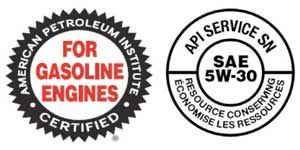
These are the labels you'll find on every container of reputable motor oil. The API doughnut on the right tells you if the oil meets a electric current service rating. Information technology also provides the SAE (Society of Automotive Engineers) viscosity number and tells you if the oil has passed the Resource Conserving test. The starburst symbol on the left indicates that the oil has passed the service tests listed in the other doughnut.
Viscosity
Viscosity refers to a fluid'southward resistance to period. Almost motor oils' viscosity is rated based on how thick it is at aught degrees Fahrenheit (represented by the number preceding the W, which stands wintertime, as well as its thickness at 212 degrees (represented by the 2nd number after the nuance in the viscosity designation).
Motor oil becomes thinner and runnier as information technology heats up and thickens as information technology cools. Within reason, thicker oil generally maintains a better film of lubrication betwixt moving parts and seals vital components of your engine improve. With the correct additives to help it resist thinning too much in the heat, an oil tin be rated for one viscosity when cold and another viscosity when hot. The more resistant oil is to thinning, the higher the 2nd number (10W-forty versus 10W-thirty, for example) will exist, and that'south adept.
Meanwhile, in low temperatures, oil has to be resistant to excessive thickening so it can withal flow properly to all the moving parts in your engine. Excessive thickness can make it more difficult to showtime the engine, which reduces fuel economic system. If the oil is too thick, the engine requires more energy to turn the crankshaft, which is partly submerged in a bath of oil. A lower number is better before the W for cold-atmospheric condition functioning, so a 5W oil is typically what'due south recommended for winter use. Nonetheless, synthetic oils can be formulated to menses even more easily when cold, and then they are able to pass tests that run across the 0W rating.
One time the engine is running, the oil heats upwardly, which is why a college second number is especially of import for extreme uses and hotter-running, more complicated engines.
Why So Many Oils?
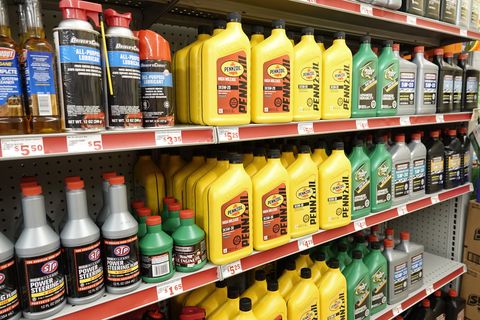
Look in auto parts stores and you'll run into oils labeled for all kinds of specific purposes: high-tech engines, new cars, higher-mileage vehicles, heavy-duty/off-road SUVs, and even cars from certain countries. Y'all'll run into a broad selection of viscosities.
If you read your possessor'south manual, you'll know what oil the vehicle's manufacturer recommended to employ when it was brand-new. The manual may include a reference to Energy Conserving or Resources Conserving oils, which means that the oil passed a fuel economic system lab test against a reference oil. While that doesn't ever translate to amend fuel economy, most leading brands accept at least some viscosities that are labeled equally such.
How to Cull Between Constructed and Conventional Motor Oil
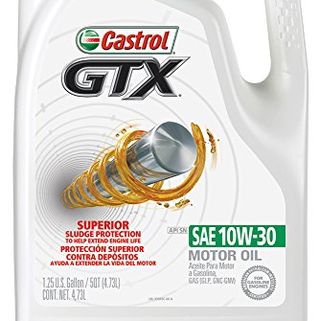
Premium Conventional Oil: This is the standard new-machine oil. All leading brands accept these oils, which are available in several viscosities and tested under the latest API service level. Automakers usually specify a 5W-twenty or 5W-30 oil for colder temperatures, with a 10W-thirty oil as optional for higher ambient temperatures. These 3 ratings cover most lite-duty vehicles on the road. Even more of import, though, is changing the oil and filter regularly. We recommend changing your oil every 4,000 miles or four months. The accented minimum is twice a year. If your car has an electronic oil-change indicator on its musical instrument cluster, follow its guidance instead and be sure to reset information technology one time your oil change is done.
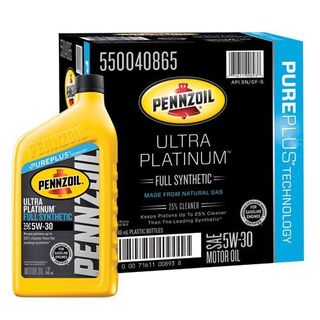
Total Synthetic Oil: Oils made for high-tech engines or heavy-duty uses, exist it a Ford F-150 that tows frequently or a Chevrolet Corvette with the latest supercharged LS engine, are full of synthetic additives. These oils' labels indicate whether they've passed stringent special tests for superior, longer-lasting performance in all the critical areas, from viscosity alphabetize to protection against deposits. They flow better at low temperatures and maintain top viscosity at high temperatures. So, why shouldn't everyone use them? These oils are expensive and non every engine needs them. In that location may even exist some features that your engine needs that synthetic oils don't have. Once more, follow the guidance in your owner'southward manual.
Synthetic Blend Oil: These have a dose of constructed oil mixed with organic oil, and are formulated to provide protection for somewhat heavier engine loads and high temperatures. This generally means they're less volatile, so they evaporate far less, which reduces oil loss and increases fuel economic system. These oils are popular with drivers of pickups or SUVs who want extra protection for activities that put more than stress on the engine, such every bit hauling heavy loads. They're also much less expensive than full synthetics—sometimes just pennies more than a premium conventional oil.
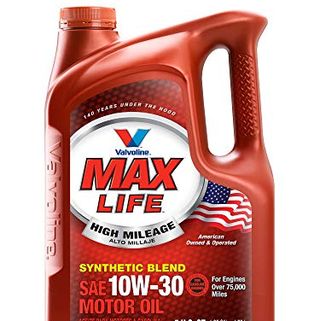
Higher-Mileage Oil: Today's vehicles simply last longer. If you lot adopt to pay off your car and run the mileage well into the six figures, you lot accept another oil choice:, oils formulated for college-mileage vehicles. Well-nigh two-thirds of the vehicles on the road have more than than 75,000 miles on the odometer. Consequently, oil companies identified this as an area of customer interest, and have new oils they're recommending for these vehicles.
When your vehicle is somewhat older and has considerably more than mileage, you may discover a few oil stains on the garage floor. Engine seals such equally those around the crankshaft may have hardened and lost their flexibility, so they leak and may crack, especially at lower temperatures. You'll demand to cheque your oil levels more oft and may need to top off your oil between oil changes.
Higher-mileage oils are formulated with conditioners that flow into the pores of the engine seals to restore their shape and increase their flexibility. Almost safety seals are designed to swell just enough to cease leaks, and oil refiners option their "reswelling" ingredients advisedly. Valvoline showed us the performance data of one of their seal conditioners that caused most seal materials to swell while reducing the swelling of one seal fabric that tended to aggrandize too much from the ingredients found in some other engine oils.
You also may have noticed some loss of performance and engine smoothness due to engine wear on your higher-mileage vehicle. These higher-mileage oils also have somewhat higher viscosities. Even if the numbers on the container don't indicate it, there's a adequately wide range for each viscosity rating and the higher-mileage oils sit at the top of each range. They may also have additives to improve their viscosity index. The result? They seal your pistons better against their cylinder walls and won't leak equally much through larger engine bearing clearances that take worn down with fourth dimension. They likewise may take a higher dose of antiwear additives to try to dull that wear process.
If you take an older vehicle, these features may mean more to you than what you might get from a total synthetic at a fraction the toll.
Going Deeper
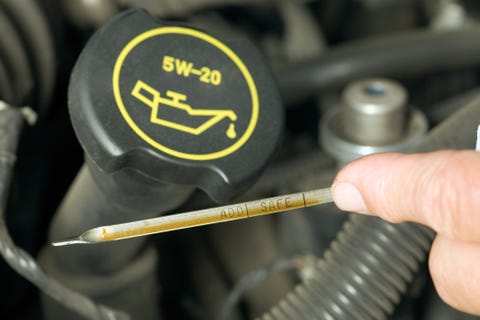
An oil's resistance to thinning in hotter temperatures is called the viscosity alphabetize. Although a higher second number is good, the oil also has to exist robust, lasting for thousands of miles until the next oil change. Oil tends to lose viscosity from shear, which is the sliding motion in the tight clearances between metal surfaces,such as those found in bearings. So, resistance to viscosity loss—chosen shear stability—is necessary to enable the oil to maintain the lubricating film between those parts.
Dissimilar antifreeze, 95 percent of which is made up of ane base of operations chemical (typically ethylene glycol), petroleum-based engine oil contains a mixture of several different types of base oils—some of which are more expensive than others. Oil companies typically pick from a selection of 5 groups, each of which is produced in a different way and in dissimilar viscosities. The more expensive groups are more than highly candy, in some cases with methods that produce a lubricant that can be classified as a constructed. The so-called full synthetics incorporate chemicals that may be derived from petroleum but are then altered that they're not considered natural oil anymore. For example, one custom blend independent x percent polyalphaolefins (PAO), which is the nigh mutual type of chemical used equally the primary ingredient in a full constructed oil.
The base oil package in whatever oil makes up anywhere from 70 to 95 pct of the mix; and the residual is composed of additives. An oil with just 70 percent base of operations oils isn't necessarily better than i with 95 pct base oils. Some base of operations oils have natural characteristics or ones that derive from their processing, which reduce or eliminate the need for additives. Although some additives make improvements lubrication, they don't necessarily have great lubricity on their own.
The ingredients in an additive package differ in cost, but price is just one factor. Some additives piece of work better in sure combinations of base of operations oils. Likewise, some less expensive base oils are a practiced choice for a alloy considering of the way they perform with popular additives. Bottom line: Every motor oil has a recipe. Refiners come up with a list of objectives based on the needs of their customers (including the carmakers themselves) and formulate oils to meet those goals equally best they can.
Keeping an oil from thinning equally it gets hot while it takes a chirapsia from engine functioning is one thing, simply it'south besides important to continue oil from condign too thick. Using less volatile premium base oils to preclude evaporation is 1 arroyo. Evaporation of the base oil bundle non only increases oil consumption—it results in thicker oil, which decreases fuel economy.
Oil Additives
Oil companies' apply of additives is some other approach to improving and maintaining oil performance. High engine temperatures combine with moisture, combustion byproducts (such every bit unburned gasoline), rust, corrosion, engine-wearable particles and oxygen to produce sludge and varnish, which can gum upward and damage the engine. Additives help maintain good lubrication by minimizing sludge and varnish. Hither are the main categories of additive ingredients and why they're important:
• Viscosity-alphabetize improvers: These reduce the oil's tendency to thin with increasing temperature.
• Detergents: Unlike the kind you use to launder apparel, detergents in oil don't scrub engine surfaces. They do remove some deposits—primarily solids. Withal, their main purpose is to go along surfaces make clean by inhibiting the formation of high-temperature deposits, rust, and corrosion.
• Dispersants: These disperse solid particles by keeping them in a solution and so they don't come together to form sludge, varnish or acids. Some additives work both as detergents and dispersants.
• Antiwear agents: Sometimes the lubricating film created by oil breaks down, so antiwear agents have to protect the metal surfaces. A zinc and phosphorus chemical compound chosen ZDDP is a long-used favorite, along with other phosphorus (and sulphur) compounds. If you must know, ZDDP stands for zinc dialkyl dithiophosphate.
• Friction modifiers: These aren't the aforementioned as antiwear agents. They reduce engine friction and thus, can improve fuel economy. Graphite, molybdenum and other compounds are used for this.
• Pour-signal depressants: Just because a 0 degrees Fahrenheit viscosity rating is low doesn't mean that oil will flow readily at low temperatures. Oil contains wax particles that tin can congeal and reduce menstruum, and so these additives are used to keep information technology flowing in the cold.
Antioxidants: With tighter emissions regulations resulting in higher engine temperatures, antioxidants are needed to preclude oxidation that thickens the oil. Some of the additives that perform other functions besides serve this purpose, such as the antiwear agents.
• Cream inhibitors: The crankshaft whipping through the oil in the oil pan causes oil to foam. Oil foam is not as effective a lubricant as a liquid stream, and then oils accept foam inhibitors that crusade the foam bubbles to collapse.
• Rust or corrosion inhibitors: These protect metal parts from acids and moisture.
More Is Not Improve
You can't necessarily improve an oil by putting in more additives. In fact, you tin make things worse. For example, sulphur compounds have antiwear and antioxidation characteristics, simply they can reduce fuel economy and reduce the effectiveness of your catalytic converter. Too much of a specific dispersant tin touch catalyst performance and reduce fuel economy. Antiwear and friction-reducing additives also may have ingredients that could affect catalyst performance, such equally sulphur, which companies are being pressured to apply less. Calculation tToo much of some detergents tin can also affect antiwear characteristics.
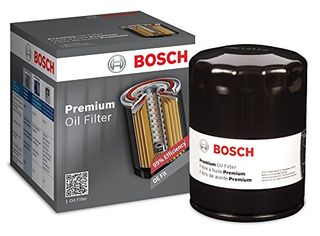
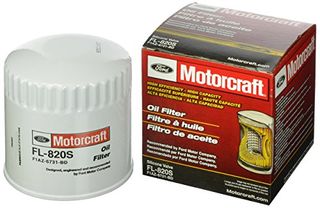
Don't Forget the Filter
Oil filters are a completely different,albeit related, subject when it comes to changing your oil. Again, it's always best to consult your owner's manual for the type of filter required. Some aftermarket filters are larger, then make sure y'all accept some actress oil if you use i.
This content is created and maintained by a 3rd party, and imported onto this page to help users provide their email addresses. Y'all may be able to discover more data near this and similar content at piano.io
Source: https://www.popularmechanics.com/cars/car-technology/a53/what-oil-does-my-car-take/
0 Response to "What Type of Oil to Put in My Car"
Post a Comment